
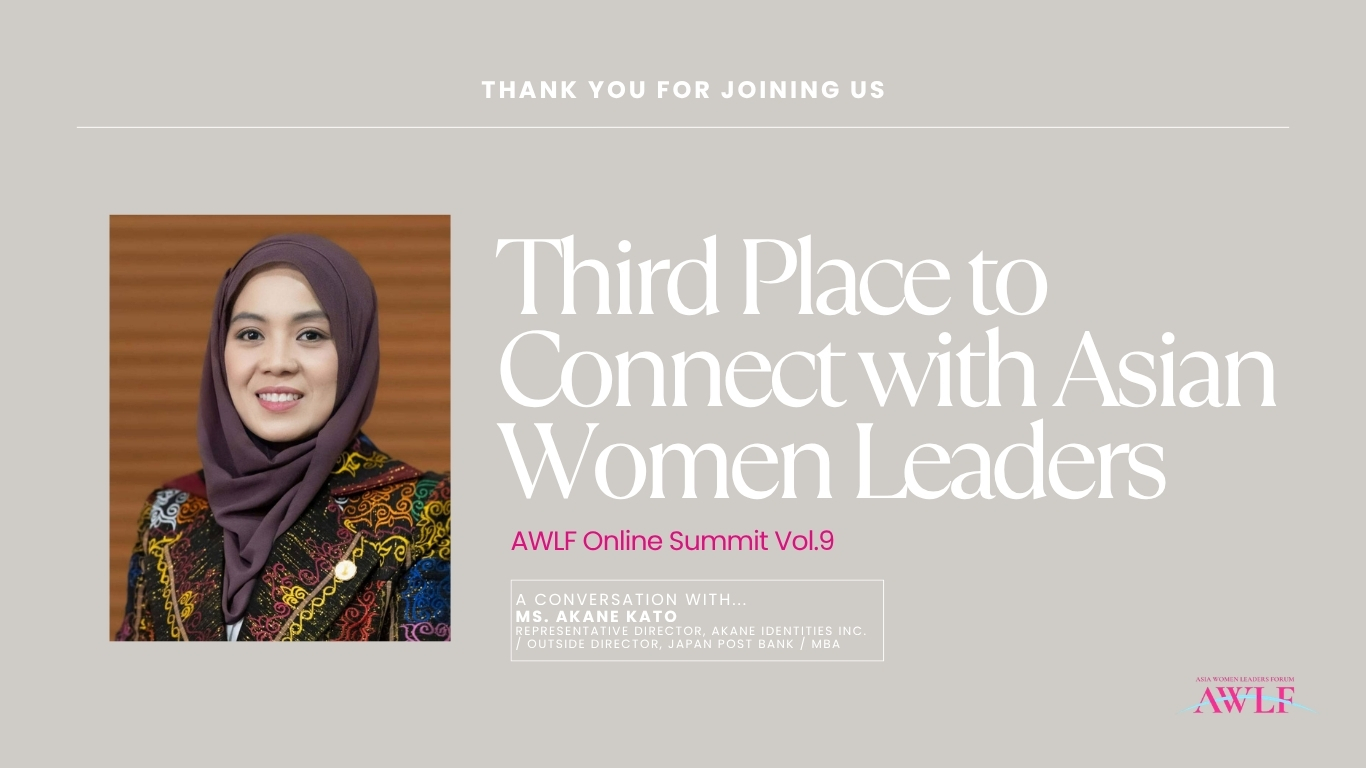
[Event Report] AWLF Online Summit Vol.9
Guest Speaker: Dr. Bai Hejira Nefertiti M. Limbona (Chancellor, Mindanao State University–Maguindanao, Philippines)
On Friday, April 10, 2026, we hosted the ninth edition of our online summit series.
This month, we welcomed Dr. Bai Hejira Nefertiti M. Limbona, a leader who has dedicated her life to building peace and nurturing the next generation through the power of education — from the heart of one of Southeast Asia’s most historically complex regions. We extend our heartfelt gratitude to everyone who participated and to Dr. Limbona for sharing her journey with such conviction, clarity, and hope.
The AWLF Online Summit serves as a “third place” where Asian women leaders come together across generations and borders for dialogue and mutual learning through shared stories and values.
■ Guest Speaker
Dr. Bai Hejira Nefertiti M. Limbona|Chancellor, Mindanao State University–Maguindanao / Ph.D. in Public Administration
Born into a Muslim family in southern Mindanao, Philippines, Dr. Limbona received fifteen years of education at Catholic institutions — an experience that instilled in her a foundational belief: that differences in religion, culture, and perspective need not divide, but can become bridges toward deeper understanding.
Having served in key university leadership roles including Vice Chancellor and Director of Student Affairs, she now leads Mindanao State University–Maguindanao as Chancellor, driving institutional reform and next-generation leadership development in the Bangsamoro Autonomous Region in Muslim Mindanao (BARMM).
MSU–Maguindanao holds a distinction unique among Philippine universities: it was established by the national government as a pacification measure in response to the Mindanao conflict, with a special mandate to integrate cultural communities into the mainstream of national civic life.
Beyond academia, Dr. Limbona contributes to civic and governance initiatives through the Red Cross, Rotary Club 3870, and the Regional Advisory Group for Police Transformation — bridging education, governance, and community development across sectors.
■ Highlights from the Keynote
“Peace is not something we wait for — it is something we build.”
During her keynote, Dr. Limbona shared her personal journey and the conviction that has guided her life’s work with remarkable candor and strength:
- Growing up as a Muslim student in Catholic institutions, and discovering that differences in faith and culture can become sources of enrichment rather than division
- The belief, shaped by her parents — both educators — that education is not merely the transmission of knowledge, but a force for transformation: for shaping minds and building better societies
- The founding philosophy behind the Institute for Peace and Development in Mindanao, which engages local leaders, women, youth, and indigenous communities in dialogue and peace-oriented initiatives
- The Fundamentals of Peace Education — a mandatory course for all incoming students across the MSU system, born in the wake of the 2017 Marawi siege
At the heart of everything she shared was one defining conviction:
“We may at times be defined by conflict. But we are also defined by the journey — and by the success stories of everyone who is still here, still building families, communities, and futures.”
This line settled quietly over the room — a reminder that hope, when grounded in action and education, endures.
■ From the Dialogue Session
In the second half, participants shared reflections and engaged in a conversation that crossed borders, generations, and lived experiences. Themes that resonated strongly included:
- A participant from Myanmar spoke with rawness and honesty about the collapse of education under political instability, and the shared frustration of communities whose governments speak of peace but fail to act on it — a reflection that opened a profound cross-border dialogue with Dr. Limbona
- A participant from Ishikawa, Japan, raised the paradox of a peaceful country whose young people are increasingly unhappy, and asked how coexistence, tolerance, and dignity — values Japan once sought to impose on others — might instead be offered as a contribution, not a prescription
- In response, Dr. Limbona reflected that Japan is a country deeply admired across Asia, and that challenges such as youth depression are shared — underscoring that no single institution or nation can solve these things alone; collaboration, mutual understanding, and a willingness to grow together are what matter most
- Participants also explored the potential for cross-sector collaboration in areas such as agriculture, healthcare, and space technology as pathways to shared development
Students from MSU–Maguindanao joined alongside participants from Myanmar, Japan, and beyond — a gathering that made the words “Asia is One” feel not aspirational, but lived.
■ Looking Ahead
AWLF continues to work toward its vision of cultivating one million women leaders from Asia by 2030, with a major international summit scheduled for September 2026 at the United Nations ESCAP headquarters in Bangkok, bringing together 300 Asian women leaders — including 100 youth leaders.
This online summit was yet another step toward that shared future: an evening where perspectives deepened, connections formed, and the good cycles we are building together grew a little stronger.
Our next online summit (Vol.10) will be held on the second Friday of May 2026. We are honored to welcome Ms. Sangita Adhikari — Chair of the AWLF Nepal Committee and Director of HUMAN RESOURCES Co., Ltd. — a social leader who has spent nearly two decades supporting Nepali women and building bridges between Japan and Nepal. We warmly invite you to join us.
🌍 Support AWLF’s Vision
Make a contribution toward our 2026 UN Summit:
🔗 https://buy.stripe.com/3cs4gIbhS3fY05WdQR
Receive updates via LINE:
🔗 https://lin.ee/isf5R0L